
The Theatiner Church – a historic jewell of Munich

The history of the Theatinerkirche
The Theatinerkirche was built in gratitude for the birth of the long-awaited heir to the throne, Max Emanuel. His parents, Elector Ferdinand Maria and his wife Henriette Adelaide of Savoy, commissioned the Italian architect Agostino Barelli in 1662 to design what they envisioned as the “most beautiful and valuable church.” Construction began just months later with the laying of the foundation stone on 29 April 1663.
Due to disputes between the architect and the site manager in 1674, the church’s exterior façade remained unfinished for many years. It was not until around a century after its consecration that François de Cuvilliés designed a Rococo-style façade in 1765, later completed by his son, François de Cuvilliés the Younger. During the Second World War, the church suffered severe damage and was rebuilt between 1946 and 1955. Today, it is cared for by the Dominican Order, which has maintained a small community at St. Cajetan since 1954.
The interior – entirely in white
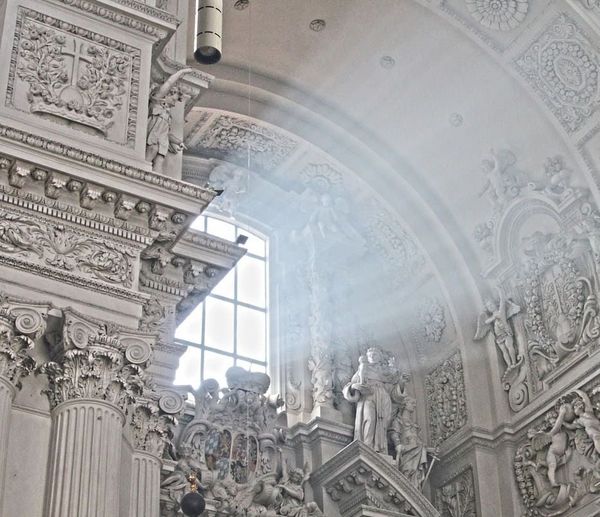
Visitors are often surprised upon entering the Theatinerkirche. The interior, developed from 1674 by Lorenzo Petri and Giovanni Viscardi, is strikingly simple in its all-white color scheme. What stands out instead is the elaborate decoration: massive columns, delicate stucco work, and a grand dome rising 70 meters high. Particularly impressive is the majestic high altar with its larger-than-life statues, which integrates seamlessly into the overall artistic composition of the church.
The princely crypt
As a court church, the Theatinerkirche included a princely crypt from the outset. Alongside St. Michael’s Church and the Frauenkirche, it is one of the most important burial sites of the Bavarian ruling house, the Wittelsbach dynasty. A notable tradition was that the hearts of deceased nobles were interred separately in the Chapel of Grace in Altötting. Today, the crypt holds 49 members of the ruling family, including Emperor Charles VII, Otto I, King of Greece, Elector Ferdinand Maria and his wife Henriette Adelaide of Savoy, as well as Prince Regent Luitpold of Bavaria.
Insider tip
The Theatinerkirche was built at a time when many buildings still lined Theatinerstraße up to Briennerstraße, which is why its façade was designed to be unusually elongated. From Odeonsplatz, the church appears especially grand and imposing. From the narrow streets leading toward Marienplatz, however, its refined and delicate architecture becomes more apparent. It is worth taking the time to explore St. Cajetan from different perspectives during a walk.
Services at the Theatinerkirche
The Theatinerkirche is open daily for visits and services from 6:30 am to 8:00 pm. During the Christmas season, the program is complemented by special Advent services. Further information is available at www.theatinerkirche.de
Image source: © 2019 – Guido F. R. Radig