Freising – discover the oldest city of Upper Bavaria

[Translate to Englisch:]
Freising is a hidden gem. Not only is Freising 1,300 years old, making it considerably older than Munich, it is also one of the oldest cities between Bolzano and Regensburg. History can be experienced here in a wonderfully relaxed atmosphere, with the Domberg, the winding old town and the green banks of the Isar providing the perfect setting for a day trip.
1300 years of history – from Frigisinga to Freising
The first signs of settlement in the region date back to the Neolithic Age. The original name of Freising, 'Frigisinga', probably derives from the Celtic personal name 'Frigis'.
Initially developing from a ducal palace, Freising became a 'spiritual city' and one of the four bishoprics in what was then Bavaria, alongside Regensburg, Passau and Salzburg. It then rose to become an independent prince-bishopric. However, it was only during the process of secularisation in 1802/1803 that it was incorporated into the Bavarian Electorate, with the bishop's seat being moved to Munich. Following numerous changes since its final establishment in 1819, Freising's coat of arms now features the famous bear from the legend of St Corbinian.
Cathedral of St Mary and St Corbinian
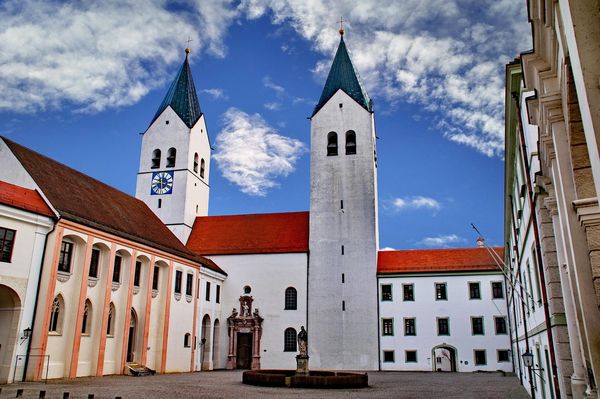
The centrally located Freising Cathedral was built in the 12th century and features Romanesque and Gothic elements. Of particular art-historical significance are the Romanesque hall crypt and the high altar, which features a copy of a painting by the renowned artist Peter Paul Rubens. The original has been in the Alte Pinakothek in Munich since 1804.
Cathedral Museum
The Diocesan Museum of Christian Art of the Archdiocese of Munich and Freising is one of the world's largest ecclesiastical museums. The collection spans the period from Romanesque to Rococo. Works by Erasmus Grasser, Lucas Cranach and Johann Baptist Straub can be admired there, among other things.
Marian Column on Marienplatz
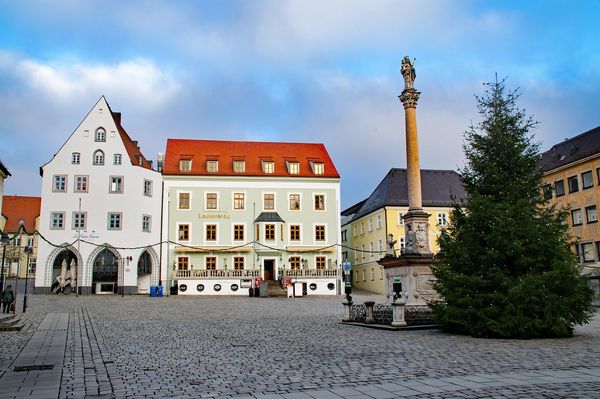
The Marian Column on Freising's Marienplatz was donated by Bishop Albrecht Sigismund in 1674. It is likely that the Freising Marian Column was modelled on the Marian Column in Munich, which was erected in 1637 to commemorate the city's survival of the Swedish invasion in 1632 and the plague in 1634.
Freising today – lively, green & enjoyable
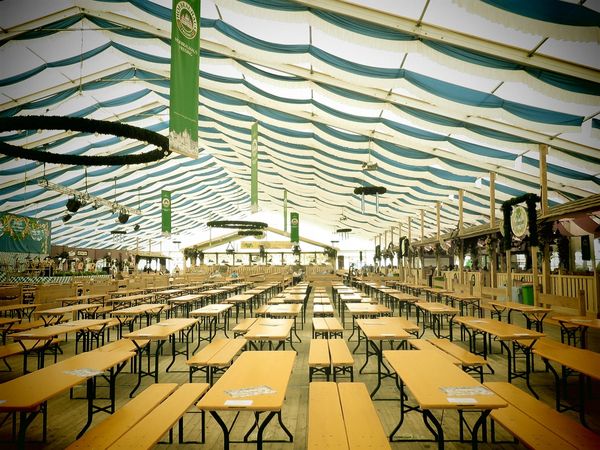
In addition to its history, Freising is a great place to live: walks along the Isar, cosy beer gardens, the Weihenstephan-Triesdorf University of Applied Sciences and a young cultural scene create a relaxed, almost village-like atmosphere with an urban flair.
Getting there: How to get to Freising
Freising can be easily reached by taking the S-Bahn S1 towards Freising/Flughafen.
Important: The train splits in Neufahrn – please sit in the front part of the train.
The journey from Marienplatz takes about 45 minutes. From the station, the cathedral, cathedral museum and Marian column are about 10–15 minutes' walk away (approx. 900 m).